Baby on Board
First Impression: A Friendly and Functional Design
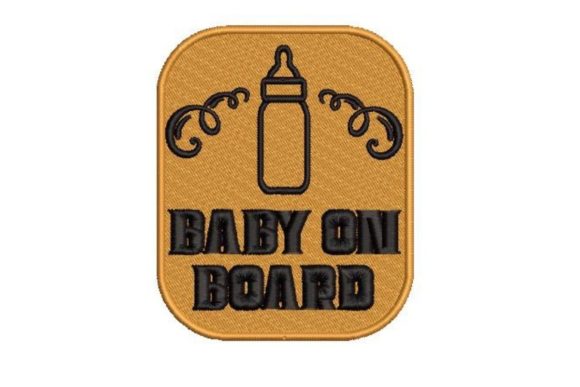
The Baby on Board design immediately feels approachable and practical. Its clean, readable text and simple layout suggest it’s meant for real-world use rather than just decoration. The title itself is clear and purposeful, which is a strong indicator of its intended function—signage for vehicles with infants. The description mentions that it stitches out nicely on any fabric, which speaks to its versatility and ease of use. This makes it a promising candidate for small business merch and branded patches.
Business Use Potential: From Patches to Product Labels
Baby on Board has broad appeal across various business applications. As an embroidered patch, it could serve as a subtle yet meaningful branding element for businesses targeting parents or family-oriented customers. It’s also suitable for cap embroidery, apron embroidery, and even tote bag design where visibility and clarity are key. For a boutique or café, it might be used as a brand identity asset on aprons, uniforms, or product packaging accents. The simplicity of the design ensures it can be adapted easily to different formats without losing its core message.
Additionally, Baby on Board could be used as a customer gift or event merchandise, especially for baby showers, parenting classes, or family-friendly events. Its universal message makes it relevant across multiple industries, from pet brands to florists and bakeries. As a digital embroidery file, it offers flexibility for custom apparel and small business merch projects, allowing businesses to maintain visual consistency across their product lines.
Design Considerations for Commercial Embroidery
While Baby on Board looks great in concept, there are several factors to consider before using it for commercial production. First, the design should be tested in black and white to ensure legibility on dark fabrics. The text is straightforward, but the spacing and lettering need to be reviewed for clarity at small sizes, such as on a patch or cap front. If the design includes intricate details or outlines, they may not translate well to smaller formats or textured surfaces.
Another important consideration is stitch density. High stitch counts can add detail but may also increase production time and cost. Businesses should evaluate whether the design’s complexity is worth the additional effort, especially for mass-produced items like custom apparel or handmade products. Additionally, the hoop size required for the design should be checked to ensure it fits within standard embroidery machines, which is crucial for both hobbyists and professional embroiderers.
Best Practices for Using Baby on Board in Real Projects
To maximize the effectiveness of Baby on Board, follow these best practices. Start by testing the design on a printable mockup to visualize how it will look on different fabrics and backgrounds. Next, confirm the thread colors and contrast to ensure the design stands out, particularly on dark uniforms or garments. Using the right stabilizer is essential for maintaining fabric integrity during stitching, especially on delicate or textured materials.
Before full-scale production, create a mockup for client approval and compare the design with other design assets to ensure brand consistency. Finally, verify that the commercial licensing is appropriate for the intended use, whether it's for a single project or ongoing merch production. These steps help ensure that Baby on Board delivers both quality and value in real-world applications.
Where to Use Baby on Board Carefully
While Baby on Board is versatile, it’s important to use it wisely in certain contexts. On small patches, the design may appear too large or crowded, so scaling down or simplifying the text could be necessary. Similarly, on curved surfaces like caps or tote bags, the design may lose some clarity unless carefully adjusted. Tiny lettering or high stitch density can also affect the overall appearance, especially when applied to frequently washed items like aprons or work shirts.
For businesses aiming to maintain a premium or handmade presentation, Baby on Board offers a balance between functionality and aesthetic appeal. However, it’s advisable to review the design’s adaptability to different fabric types and surface textures to avoid potential issues during production.
Impact on Brand Identity and Customer Engagement
Using Baby on Board in your brand identity can enhance customer trust and recognition. Its friendly and welcoming message aligns well with businesses that cater to families or emphasize community. By incorporating this design into custom apparel or product labels, you reinforce your brand’s values while providing a unique selling point.
Moreover, Baby on Board can boost buyer engagement by offering a recognizable and meaningful element to your merchandise. Whether it’s a handmade product or a commercial embroidery item, the design adds value through its relevance and visual appeal. It also supports visual consistency, helping your brand stand out in a competitive market.
Final Thoughts on Baby on Board
Baby on Board is a well-crafted design that balances simplicity with functionality. It’s ideal for small business merch, custom apparel, and brand identity projects that require both clarity and charm. While it may need some adjustments for specific applications, its adaptability makes it a valuable asset for embroidery shops, Etsy sellers, and craft businesses looking to expand their offerings.